


Edge AI: When Hardware Meets Efficient AI
Craftwise
·enero 18, 2026
On this page:
While most attention is still on LLMs (large language models) running in the cloud, a quieter and very practical shift is underway: smaller language models running locally on end-user devices (Edge AI).
Small Language Models (SLMs) are improving rapidly. Research shows that well-trained language models under 8 billion parameters, can deliver strong results for many tasks when combined with task-specific fine-tuning and optimization techniques such as quantization and distillation. These models are cheaper to run, faster to iterate on, and far more deployable on personal devices.
At the same time, modern laptops and smartphones are now powerful enough to run meaningful AI workloads directly on device. CPU and GPU performance keeps improving, and NPUs are now integrated into consumer hardware, specifically designed to accelerate neural networks efficiently and at low power.
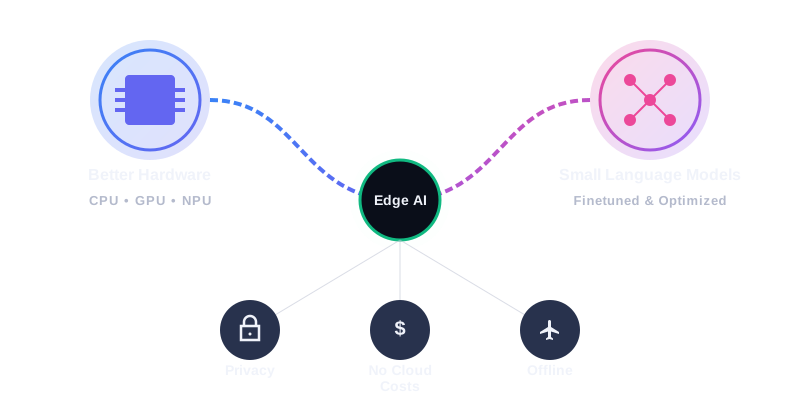
The convergence is clear: better consumer hardware + more capable small models. It is becoming more and more possible to run an increasing number of AI workloads locally, either on consumer hardware or on small in-house servers.
This matters for three reasons:
Cost: Running inference locally avoids additional cloud costs, or allows using cheaper cloud hardware.
Privacy: Data stays on the user’s machine instead of being sent to external servers.
Offline: AI workloads can run on customer hardware without an internet connection or with poor connectivity.
We believe the future of AI won’t be only centralized and cloud-based. A significant part of it will run directly on personal computers and smartphones, quietly and privately. And the environmental impact would be much less devastating as well!
Interesting Papers About SLMs
- SLM-Bench: A Comprehensive Benchmark of Small Language Models on Environmental Impacts
- Small Language Models are the Future of Agentic AI
- Small Language Models for Efficient Agentic Tool Calling
Definitions
Edge AI: The deployment of artificial intelligence algorithms and models directly on end-user devices (“at the edge”) rather than in remote cloud servers. The key idea is that data is processed on the device where it’s generated (like a phone, camera, IoT sensor, laptop, or embedded system), reducing latency, preserving privacy, and lowering dependency on a network connection.
Fine-tuning: The process of taking a pre-trained language model and further training it on a specific task or dataset. This allows the model to adapt its general knowledge to perform better on particular use cases without requiring training from scratch.
Quantization: A technique that reduces the precision of model parameters (e.g., from 32-bit floating point to 8-bit integers) to decrease model size and memory requirements while maintaining acceptable performance. This is crucial for running models on resource-constrained devices.
Distillation: A training method where a smaller “student” model learns to mimic the behavior of a larger “teacher” model. The student model captures the essential knowledge of the teacher while being more efficient and deployable on edge devices.
NPU (Neural Processing Unit): A specialized processor designed specifically for accelerating neural network computations. Unlike general-purpose CPUs or GPUs, NPUs are optimized for AI workloads, offering better performance per watt and enabling efficient on-device AI inference.